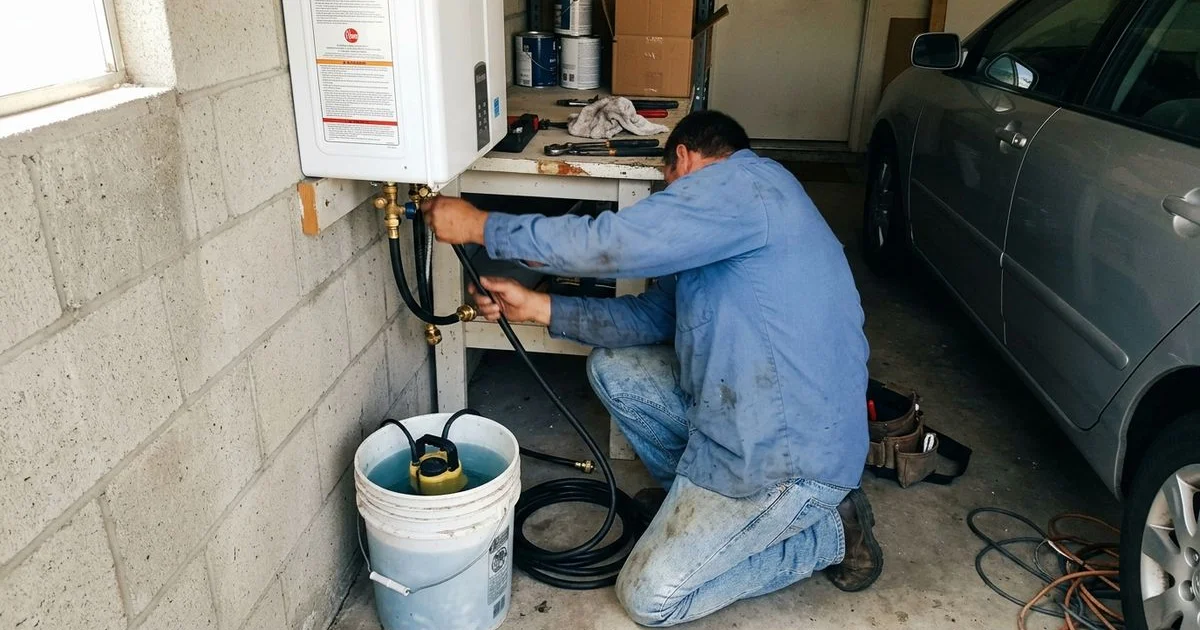
A tankless water heater is often sold as install-it-and-forget-it. In hard water it’s closer to install-it-and-put-it-on-the-calendar. Victorville’s Mojave River basin groundwater is hard (the current figure is in the Victorville Water District’s Consumer Confidence Report), and tankless units are the appliance in the house most sensitive to scale.
Why Tankless Units Scale So Fast
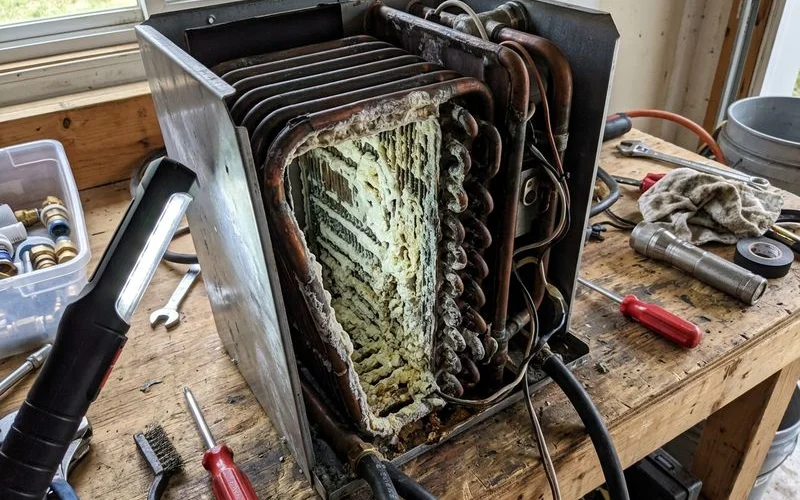
A tank heater warms 40 or 50 gallons slowly, and much of the sediment drops to the bottom, out of the way. A tankless unit pushes water through narrow heat exchanger passages and heats it in seconds. Fast heating on a hot metal surface is exactly where scale forms fastest, and there’s very little room in those passages for it to build up.
Realistic Intervals
| Your situation | Suggested interval |
|---|---|
| Untreated hard water, average household | At least every 12 months |
| Untreated hard water, large household or heavy use | Every 6 to 9 months |
| Softened water upstream | Often every 18 to 24 months, confirmed by inspection |
| Unit already showing scale-related error codes | Descale now, then start a schedule |
| Unit installed without service valves | Add valves, then follow the schedule above |
Simple rule: if the unit has run more than a year in hard water and nobody has flushed it, it’s overdue.
The Four Stages of Skipped Descaling
- Efficiency loss. Scale insulates the heat exchanger. The burner runs longer for the same hot water, and energy bills creep up.
- Inconsistent output. Restricted passages cause hot-cold-hot swings in the shower and weaker flow at busy times.
- Error codes and shutdowns. The unit senses overheating or low flow and shuts itself off. Many manufacturers have a specific code for scale buildup; check your manual.
- Heat exchanger damage. A heavily scaled exchanger runs hot enough to be damaged. On many units, that repair costs enough that a new heater starts to make sense.
It looks like a defect, but it isn’t
A common pattern: the unit works perfectly for a couple of years, then starts acting up. It looks like a factory problem. Usually it’s maintenance nobody was told about when the unit went in.
What a Descaling Service Involves
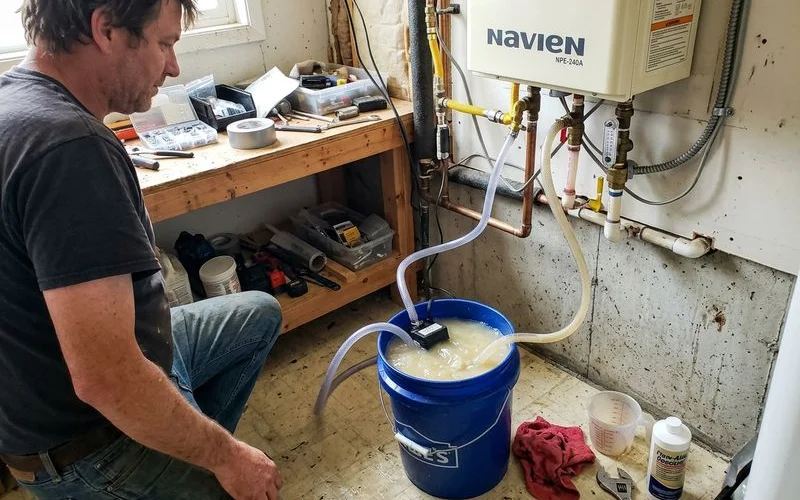
- Shut down and isolate. Power and gas off, then the isolation service valves closed to separate the unit from the house plumbing.
- Connect the pump loop. Hoses go from the service ports to a small submersible pump in a bucket of descaling solution.
- Circulate. The solution runs through the heat exchanger for the time the manufacturer specifies, dissolving scale.
- Rinse. Fresh water flushes out the solution and loosened scale.
- Clean the inlet filter. The small screen on the cold inlet catches debris and needs cleaning.
- Restart and check. Valves reopened, unit fired, temperature and flow checked.
Use a descaler the manufacturer approves. Plain vinegar works on light scale but is slower on heavy buildup.
If the unit was installed without isolation valves, they need to be added before it can be flushed. That’s a worthwhile one-time upgrade that makes every future service quicker.
Cold-Night Note for Outdoor Units
Some tankless heaters are mounted outside. Many have built-in freeze protection that needs power to work, so a power outage on a freezing High Desert night can put the unit at risk. Check your manual for its freeze-protection and drain-down steps, and insulate exposed water lines around the unit.
How a Softener Changes the Schedule
A correctly sized softener removes most of the hardness before water reaches the heater, so far less scale forms in the heat exchanger. That’s often the strongest argument for treatment in a house with a tankless unit: it protects an expensive part, not just the shower glass. Our water softeners page covers sizing.
Getting on a Schedule
Victorville Plumbing Pros answers 24/7 through a bilingual automated assistant that routes descaling and repair requests to a local plumber for water heater service. Request a free estimate, and ask about any service call fee when you call. Write the date of each descaling on the unit so the next one is easy to plan.