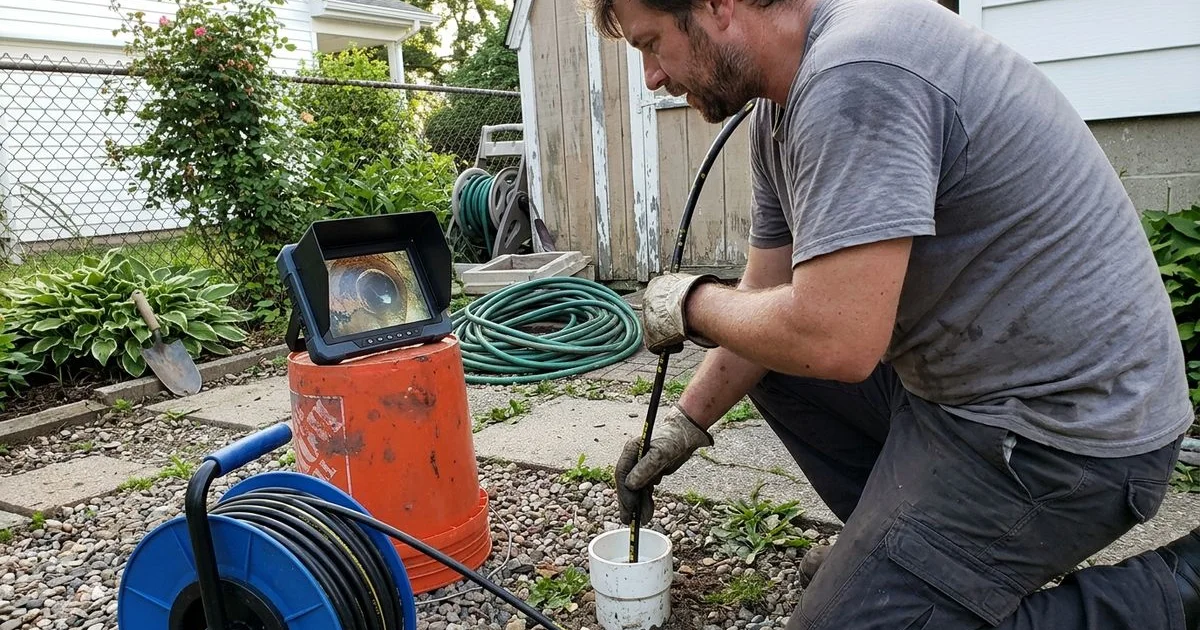
A drain line runs underground from your house to the street, and until something goes wrong, nobody thinks about it. When something does go wrong, guessing gets expensive. A sewer camera inspection replaces the guessing with footage of the actual inside of the pipe.
The Equipment, in Plain Terms
- The camera head. A small, waterproof, lighted camera on the end of a flexible push cable. Many heads stay level so the picture doesn’t spin.
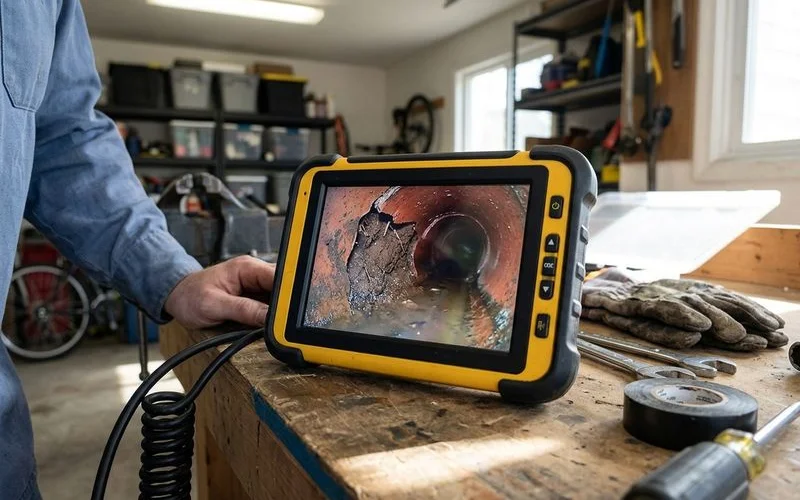
- The monitor. Shows the live picture and usually records it, often with a distance counter so each defect can be tied to a footage mark.
- The sonde and locator. A transmitter in the camera head sends a signal. A handheld locator above ground picks it up and shows where the camera is and roughly how deep.
The camera usually goes in through a cleanout. If there isn’t one, it can go through a pulled toilet or a roof vent. If the line is completely blocked, it often has to be cleared first, because the camera can’t see past standing sewage.
What Shows Up on the Screen
| Finding | What it looks like | What it usually means |
|---|---|---|
| Crack or break | A dark line or a hole, sometimes with soil visible | Water leaking out, soil getting in; it will grow |
| Belly | The camera drops into standing water that doesn’t drain | The pipe has sagged; waste settles there |
| Offset joint | A lip where one section doesn’t line up with the next | Ground movement shifted the pipe; solids snag on it |
| Roots | Hair-like strands or a dense mat at a joint | Roots got in through a gap; they’ll regrow after cutting |
| Grease or scale | Walls coated and narrowed | Flow is restricted; jetting may help |
| Corrosion | Rough, flaking, or bumpy walls in metal pipe | Older cast iron wearing thin |
| Collapse | Pipe shape lost, soil filling the line | Clearing won’t work; repair is needed |
| Clean, round pipe | Smooth walls, good slope | A one-time clog, not a pipe problem |
That last row matters. Footage of a sound pipe can save you from a repair you don’t need.
Patterns by Home Age
Newer tract homes, common around Victorville, usually have plastic drain lines. Plastic doesn’t rust, so camera findings in these homes tend to be about how the pipe sits in the ground: bellies from settled trench backfill, joints that shifted, debris left from construction, or damage from later landscaping and irrigation work.
Older homes may have cast iron or clay. Those inspections more often show corrosion, cracks, and roots at joints, and sometimes several smaller problems along the same line.
Why Locating Saves Money
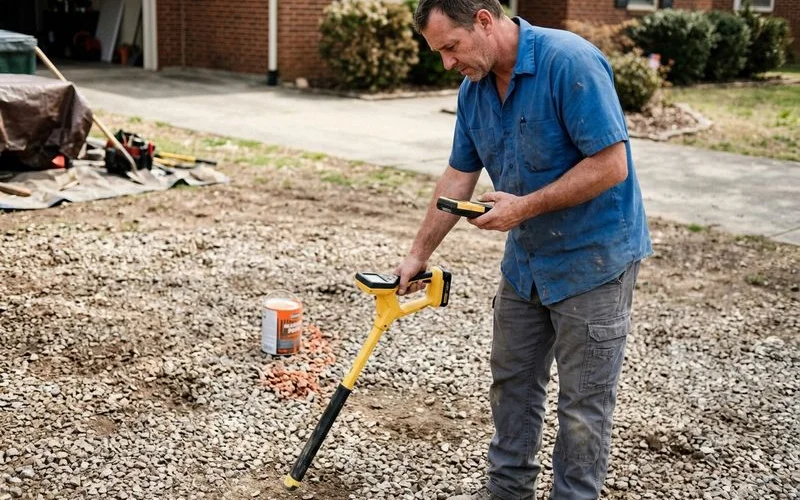
Finding a defect on screen is half the job. Knowing exactly where it is in the yard or under the slab is the other half. With the camera stopped at the problem, the locator finds the signal, and the spot is marked on the surface with paint.
That’s the difference between cutting one small opening in a driveway or slab and digging a long exploratory trench. It protects concrete, landscaping, and flooring, and it’s often the biggest single saving on a sewer repair.
Watch it live
Ask to watch the monitor while the camera runs. Hearing “there’s an offset at 40 feet” is abstract. Seeing roots hanging in your own pipe makes the repair decision much easier.
When a Camera Inspection Is Worth It
- After a second backup in a year. Once can be an accident. Twice is usually the pipe.
- Before buying a home. A general home inspection doesn’t look inside the buried line.
- Before hydro jetting an older line. High pressure in a cracked pipe can make it worse.
- After a backup that caused damage. Footage of the cause helps with insurance.
- When a repair quote is large. Ask to see the footage before approving excavation.
If you’re seeing odor, slow drains, or damp soil, our guide on signs of a broken sewer pipe under a slab explains how those symptoms connect.
Booking One
Victorville Plumbing Pros answers 24/7 through a bilingual automated assistant that routes camera inspection requests to a local plumber for drain cleaning. Request a free estimate, and ask about any service call fee when you call.